

CSLB Fire Protection (C-16): Study Guide and Online Practice Exam
$250.00
$300.00
Save $50.00
Free Shipping
30 diagrams in Fire Protection (C-16) online practice
What’s included
- Learn the material: Fire Protection Engineering (C-16) Study Guide Book
- Pass the test: Fire Protection Engineering (C-16) Practice Exam
What this covers
Per the state's classification, a C-16 contractor installs, repairs, and services fire protection systems including sprinkler systems, standpipes, fire pumps, and underground mains. This printed book covers the subjects the state tests. See the official CSLB C-16 classification.
Sample questions: Try our free practice test
-
At what temperature do in-rack sprinklers activate?
✓ A. 130 to 170 degrees F · B. 130 to 190 degrees F · C. 140 to 170 degrees F · D. 140 to 190 degrees F -
How often are fire pumps turned on and tested?
A. Daily · ✓ B. Once a week · C. Monthly · D. Once every 3 months -
PIV stands for:
A. Preaction intake valve · ✓ B. Post indicator valve · C. Pipe in view · D. Pipe in valve -
What chemical can be used to stop a small leak in a sprinkler system during a hydrostatic test?
A. Sodium silicate · B. Sodium derivatives · C. Brine · ✓ D. You should not use anything -
For what is the Hazen-Williams Formula used?
A. Fire pump efficiency · B. Flow · ✓ C. Pressure loss · D. Velocity -
An electrical contractor uses the underground mains and sprinkler mains as an electrical ground. He has proceeded:
A. correctly · B. incorrectly; only above-ground mains may be used for grounding · C. incorrectly; only sprinkler mains may be used · ✓ D. incorrectly; such mains must never be used as a ground because it may cause electrolysis
Practice with diagrams
30 diagrams in Fire Protection (C-16) online practice
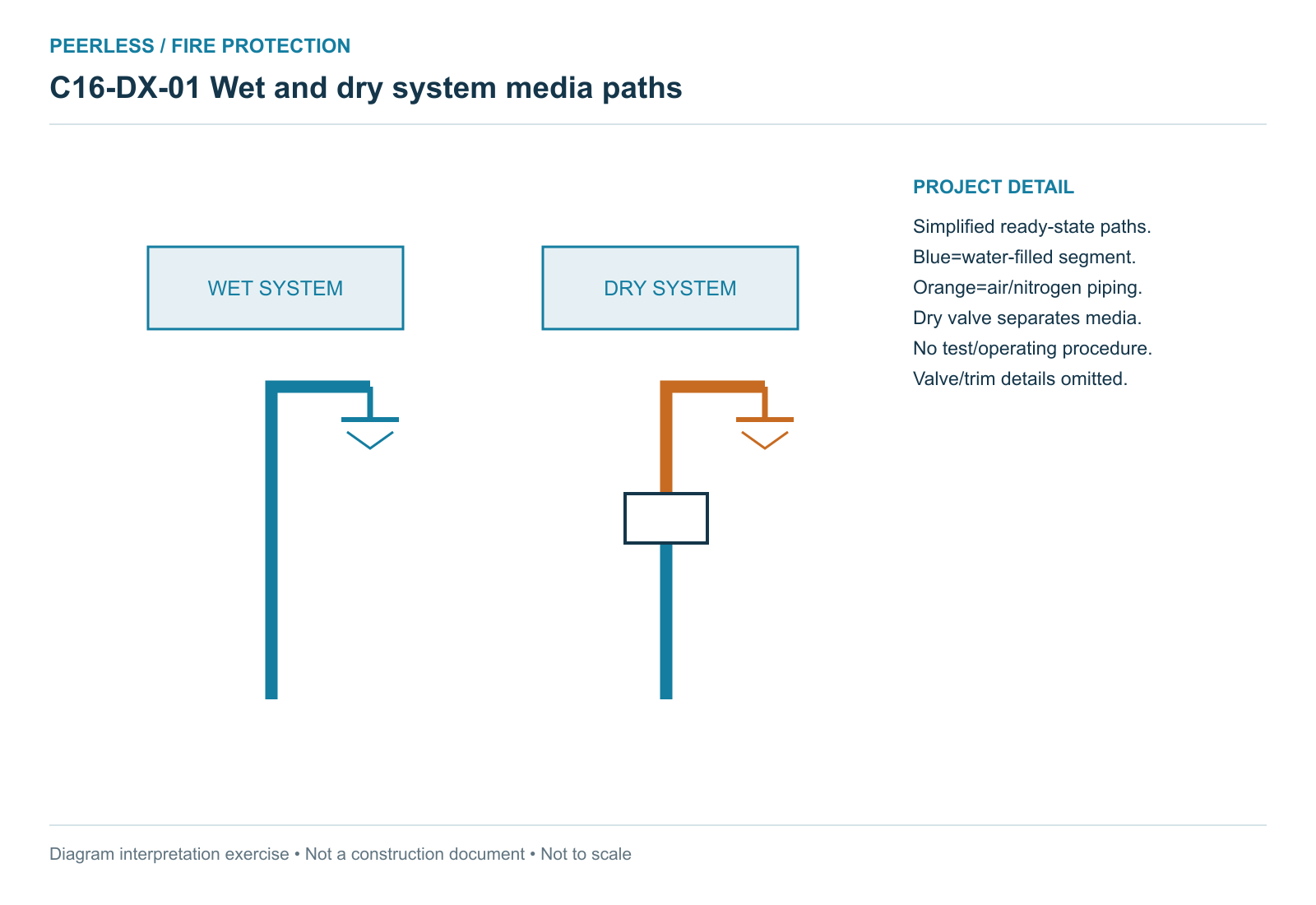
Read a sample diagram, choose an answer, then reveal the explanation. The online course includes diagram questions with feedback.
Try a sample question
Which system shows water already in the branch approaching the sprinkler?
- Both wet and dry branches
- Neither branch
- Wet
- Dry only
Show answer and explanation
C. Wet
The wet branch is blue throughout; dry branch is orange above its valve.


