Low Voltage Systems (C-7) Contractor Exam Prep
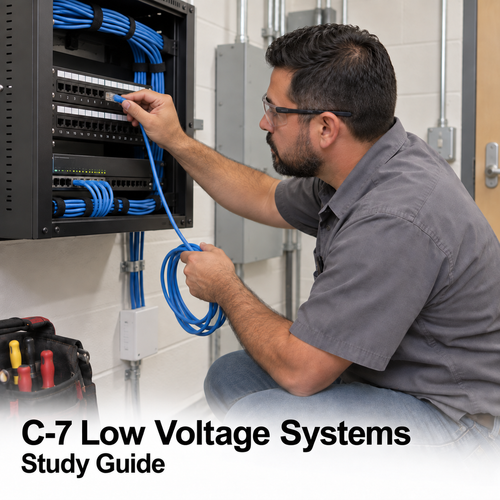
Quick answer: The California C-7 Low Voltage Systems exam covers communication and low-energy systems — data and telecommunications cabling, sound and video, intercom and signalling. Peerless prepares you with a C-7 study guide and an online practice exam.
Current CSLB C-7 Low Voltage Systems exam outline
The official CSLB C-7 Low Voltage Systems study guide applies to examinations scheduled on or after October 1, 2023. CSLB describes these percentages as approximate. The trade exam is closed book; check the current PDF and your exam notice before testing.
| Official section | Approximate weight | What to practice |
|---|---|---|
| Job Planning and Design | 18% | Interpret plans and specifications; Plan wire routes and equipment locations; Compliance with codes and industry standards |
| Material Selection and Estimation | 15% | Knowledge of materials and their applications; Knowledge of tools and equipment and their applications; Estimate project costs and prepare proposals |
| Wire/Cable Installation and Termination | 12% | Layout, install, and support pathways; Knowledge of tools and methods of termination; Placement and termination of wires/cables |
| Systems Configuration and Installation | 16% | Install equipment room components; Install satellite, CCTV, telephone, data, instrumentation, battery systems, audio/video, and fiber optic systems; Install building automation |
| Testing and Project Closeout | 17% | Tools and methods used to test the functioning of low voltage equipment; Project closeout, documentation, and training |
| System Troubleshooting, Repairs, or Replacements | 7% | Troubleshoot various problems and make repairs/ replacements |
| Safety | 15% | Cal/OSHA regulations; Identification of job site hazards; Safe work practices |
Two-, four-, and six-week study paths
Two weeks: Use this only if you already have broad recent experience and can practice daily. Diagnose on day one; spend the next several days on Job Planning and Design (18%) and Testing and Project Closeout (17%); rotate through remaining sections; finish with a timed mixed set and a review of every miss or guess.
Four weeks: Week 1: read the official guide, take a baseline, and build an error log. Week 2: work the highest-weight weak sections using drawings, calculations, or installation sequences. Week 3: cover remaining trade sections and safety. Week 4: take timed mixed sets and revisit weak topics with fresh questions.
Six weeks: Add more depth to each field section and retest a week after first reviewing it. Reserve the last week for mixed practice, the error log, and test-day instructions. These are Peerless example schedules, not CSLB requirements.
Original worked C-7 Low Voltage Systems example
Question: A rack schedule lists four cable runs as D-01 through D-04. A cable is labeled D-03 at the rack but D-02 at the outlet. What should be checked first?
Answer: Trace the run against the plan and correct the documentation/labels before closeout.
Why: A mismatched identifier is a verification problem. Do not assume which end is correct without testing or tracing.
This is an original study exercise, not a recalled CSLB question.
What the C-7 exam covers
Start with the official CSLB study guide for your classification. It publishes the topic breakdown, sample questions and reference list the exam is actually built from. Peerless C-7 materials are written to support those topic areas, which typically include:
- Communication and data cabling
- Copper and fibre optic media
- Terminations, connectors and testing
- Telephone, intercom and paging systems
- Sound, video and distributed audio
- Signalling and control systems
- Raceways, pathways and support
- Grounding and bonding for low-voltage work
- Plans, specifications and as-builts
- Safety
Confirm the current topic list against the CSLB examination study guides, since CSLB revises them periodically.
How to study for the C-7
Reading cover to cover is the most common way applicants run out of time. A tighter loop works better:
- Read one C-7 topic in the study guide.
- Work the practice questions for that topic.
- Review every missed answer and note whether the gap was media and termination detail, systems knowledge, or code.
- Go back to the weak topics instead of restarting from page one.
- Take a full practice exam under timed conditions.
- Repeat until your weak sections stop moving.
Not sure where you stand? Take the free C-7 practice test first and let the result tell you how much study time you actually need.
Who Peerless is a good fit for
Peerless is a strong fit if you want:
- A focused C-7 study guide written for the California exam
- An online C-7 practice exam with instant scoring
- Self-paced study that fits around jobs and crews
- A lower-cost alternative to a full multimedia course
- The option to prepare for the trade exam and Law & Business together
Another provider may suit you better if you need:
- Video or audio lessons
- Flashcards or a dedicated mobile app
- Live instructor support or one-to-one tutoring
- Help filing or reviewing your CSLB application
C-7 or C-10? Get the classification right first
This is the most common and most expensive mistake on this trade. C-7 covers communication and low-energy systems. C-10 covers electrical work generally. They are separate classifications with separate exams, and buying study material for the wrong one wastes both money and weeks of preparation.
If the work you do is data, communications, sound, signalling and similar low-energy systems, C-7 is normally the right classification. If you are installing electrical power distribution, that is C-10. Confirm against CSLB's classification descriptions before you buy anything, and see the C-10 electrical guide if that turns out to be your classification.
On the prep itself: competitors offering multimedia courses have an advantage if you want systems demonstrated visually. Peerless is the lower-cost focused option — study guide plus repeated timed practice.
Do not leave Law & Business until last
Applicants for an original California licence generally sit two exams: the trade exam and Law & Business. Experienced tradespeople often clear the C-7 and then get caught by contracts, liens, employment rules and safety requirements. See the CSLB Law & Business exam guide, or take the free Law & Business practice test to check where you stand.
Frequently asked questions
What is the difference between C-7 and C-10?
C-7 covers communication and low-energy systems such as data, sound and signalling. C-10 covers electrical work generally. They are separate classifications with separate exams — check CSLB's classification descriptions before choosing your study materials.
How many questions are on the C-7 exam?
The question count varies by classification and CSLB revises its exams over time. Check the current CSLB candidate information for your exam date rather than relying on a number quoted by any prep provider.
What score do I need to pass?
California contractor licence exams are pass/fail and applicants generally need roughly 70% or better. Confirm the current standard with CSLB.
Do I need the book and the practice exam, or just one?
They do different jobs. The book teaches the material; the practice exam shows you which parts you have not actually retained. Applicants returning to study after years in the field usually benefit from both.
Sources
Peerless Institute is an independent exam prep provider and is not affiliated with, endorsed by, or sponsored by the Contractors State License Board (CSLB). Always verify current licensing requirements, fees, and exam procedures with CSLB.