How to Pass the California General Building (B) Contractor Exam
To prepare for the California General Building (B) exam, use the current CSLB outline as your study blueprint. Diagnose your baseline, give the most time to weak high-weight sections, practice the five official content areas in rotation, and review every missed or guessed answer until you can explain the underlying rule, drawing, sequence, or calculation without relying on answer memorization.
Independent-provider notice: Peerless Institute is an independent exam-preparation provider. It is not affiliated with, endorsed by, or sponsored by the Contractors State License Board (CSLB). Peerless practice questions are original study questions, not recalled state-exam content.
Choose the General B resource that matches your goal
| Your goal | Best Peerless resource | What it is for |
|---|---|---|
| Understand the exam and build a schedule | This General B exam guide | Official topic weights, two-, four-, and six-week schedules, study priorities, and section guides. |
| Check your baseline | Free General B practice test | A short diagnostic that helps identify where to begin. |
| Study from a printed book | General B printed study guide | Structured self-study organized around the trade examination. |
| Practice repeatedly online | General B online practice exam | Topic practice and mixed review on phone, tablet, or computer. |
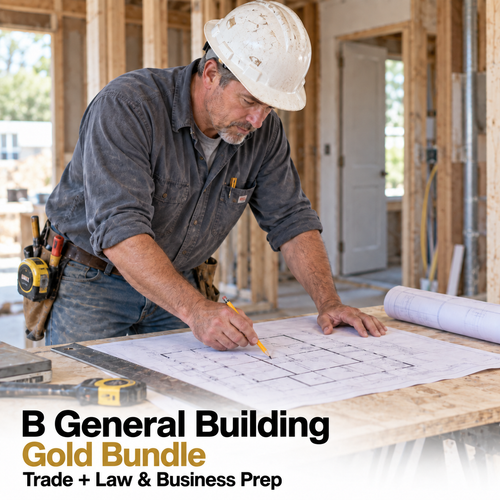
| Prepare for both required exams | General B and Law & Business bundle | Coordinated preparation for the trade exam and the separate Law and Business exam. |
Current CSLB General Building exam facts
- The current official study guide applies to General Building examinations scheduled on or after January 1, 2025.
- The examination is closed book. Reference materials cannot be used during the test.
- CSLB divides the examination into five major sections and describes the listed percentages as approximate.
- The official study guide includes a content outline, sample questions, suggested resources, and test strategy.
- CSLB requirements and testing procedures control. Recheck the current guide and your examination notice before test day.
Authoritative source: CSLB General Building (B) Examination Study Guide.
The five official General Building sections
| Official section | Approximate weight | Primary study focus | Section guide |
|---|---|---|---|
| Planning and Estimating | 15% | Scope, code compliance, error identification, plans, inspections, coordination, and estimating. | Planning and estimating guide |
| Framing and Structural Components | 20% | Subfloor and wall framing, roofs, seismic hardware, siding, stucco, decks, and stairs. | Framing and structural guide |
| Core Trades | 30% | Plumbing, electrical, HVAC, concrete, earthwork, insulation, weatherproofing, and roofing. | Core trades guide |
| Finish Trades | 20% | Coatings, tile, flooring, cabinetry, plaster, drywall, openings, and landscaping. | Finish trades guide |
| Safety | 15% | Personnel safety, transportation and traffic control, and environmental safety. | Safety guide |
Start with a baseline, then allocate study time
Take a mixed diagnostic before reviewing every chapter. Sort each missed or guessed question under one of the five official sections. A strong score in a familiar trade does not cancel a weakness in another part of the outline.
Study-time rule: official weight × weakness = priority. Begin with weak, heavily weighted areas; use shorter sessions to maintain stronger areas.
For example, a candidate with framing experience but weak mechanical coordination should not spend most of the schedule reviewing framing. Core Trades carries the largest approximate weight and spans several systems, so weak performance there deserves more time.
Two-week General B study plan
Best for: an applicant with recent, broad field experience who can study every day. This is an intensive Peerless example, not an official CSLB schedule.
- Days 1–2: read the official outline, take a mixed baseline set, and create an error log.
- Days 3–5: study weak Core Trades topics, including the order and coordination of different systems.
- Days 6–7: review Framing and Structural Components, then complete a mixed checkpoint.
- Days 8–9: rotate through Finish Trades and Planning and Estimating.
- Day 10: review Safety and any safety misses collected earlier.
- Days 11–12: practice plan reading, quantities, sequencing, and fresh mixed questions.
- Day 13: complete a timed mixed simulation and review every miss and lucky guess.
- Day 14: perform light review, revisit the error log, and confirm current test-day instructions.
Four-week General B study plan
Best for: most working applicants who can study in several shorter sessions each week.
Week 1: Diagnose and organize
Read the outline, take a baseline, set up the error log, and study Planning and Estimating plus your weakest Core Trades topics.
Week 2: Structure and systems
Review framing, roofs, stairs, seismic hardware, and the coordination of plumbing, electrical, HVAC, concrete, and roofing.
Week 3: Finishes and safety
Rotate through Finish Trades and Safety, then retest weak topics with fresh questions.
Week 4: Mixed application
Complete timed mixed sets, practice drawings and calculations, and study only the gaps shown by your results.
Six-week General B study plan
Best for: applicants who need broader review or have limited weekly study time.
- Week 1: official outline, baseline diagnostic, Planning and Estimating, and error-log setup.
- Week 2: plumbing, electrical, HVAC, and coordination among trades.
- Week 3: concrete, earthwork and surveying, insulation, weatherproofing, and roofing.
- Week 4: subfloors, walls, roofs, seismic hardware, siding, stucco, decks, and stairs.
- Week 5: Finish Trades and Safety, with mixed questions from previous weeks.
- Week 6: timed mixed practice, plan and calculation review, and targeted repair of remaining weaknesses.
What to memorize and what to understand
| Memorize or recognize | Understand and apply |
|---|---|
| Terminology, symbols, units, common abbreviations, and the categories in the official outline. | How scope, plans, specifications, codes, and field conditions affect a construction decision. |
| Frequently used formulas and the sequence of calculation steps. | When a formula applies, which dimensions belong in it, and whether the result is reasonable. |
| Basic safety vocabulary and hazard categories. | How to recognize a hazard and choose the safest appropriate response in a job scenario. |
| The role of each construction document. | How to reconcile information across plans, specifications, shop drawings, inspections, and change documentation. |
Worked calculation: concrete volume with stated waste
A slab is 30 feet by 24 feet and 4 inches thick. Convert the thickness first: 4 ÷ 12 = 0.333 feet. Volume = 30 × 24 × 0.333 = approximately 240 cubic feet. Convert to cubic yards: 240 ÷ 27 = 8.89 cubic yards. If the exercise explicitly tells you to add 10% waste, 8.89 × 1.10 = 9.78 cubic yards.
Why this matters: the calculation is only reliable when the units, dimensions, and stated assumptions are handled in the correct order. The 10% factor is an exercise assumption, not a universal requirement.
Common General B study mistakes
- Overstudying one familiar trade: the General B outline tests breadth across many systems.
- Ignoring guessed answers: a correct guess still indicates an unresolved concept.
- Memorizing answer letters: wording and facts can change while the underlying principle stays the same.
- Skipping plans and calculations: CSLB notes that most trade examinations include questions referring to accompanying blueprints or booklets containing drawings.
- Saving Law and Business for the end: it is a separate examination and needs its own study rotation.
- Treating one score as proof of readiness: look for consistent performance across fresh, mixed sets.
Prepare for General B and Law & Business together
Applicants for an original California contractor license generally take the trade examination and the separate Law and Business examination. Maintain separate error logs, but place both exams on the same calendar so one does not crowd out the other.
Use the California Law and Business exam guide for its current topic outline, then combine both schedules with the first-attempt contractor exam study plan.
Frequently asked questions
Which General Building section carries the most weight?
Core Trades carries the largest approximate weight at 30%. Framing and Structural Components and Finish Trades are approximately 20% each; Planning and Estimating and Safety are approximately 15% each.
Is the California General Building exam open book?
No. The current CSLB General Building study guide states that the examination is closed book and reference materials may not be used.
How long should I study for the General B exam?
There is no single schedule for every applicant. Choose a two-, four-, or six-week structure based on your baseline, breadth of experience, exam date, and available weekly study time.
Should I study Core Trades first?
Core Trades deserves substantial time because of its approximate weight and breadth, but begin with a diagnostic. Your weakest high-weight area should receive the first long study block.
Are Peerless practice questions actual CSLB questions?
No. Peerless questions are original study questions designed around publicly available examination topics. They are not copied or recalled from the state examination.
Is Peerless Institute affiliated with CSLB?
No. Peerless Institute is an independent exam-preparation provider and is not affiliated with, endorsed by, or sponsored by CSLB.
Official sources
- CSLB General Building (B) Examination Study Guide
- CSLB examination study-guide directory
- CSLB: Studying for the Examination
- CSLB examination FAQ
Official information reviewed October 13, 2026. Always verify current requirements with CSLB and follow the instructions in your examination notice.